One festival, one person with the full picture
SuperNova is Belgium's leading B2B inspiration event. International speakers, Belgian founders, partner booths and sponsor activations all converge in Antwerp for two intense days of programming.
Maarten Beyens carries the marketing and design side almost end to end: campaign strategy, website, advertising and coordination of the photographers and videographers on the ground. When the festival is live, the job is not just creating content. It is making sure the right image reaches the right person at the right moment.
I really couldn't do without it anymore. The tag structure makes everything so much simpler. I need a photo, I search for it, and I get it.
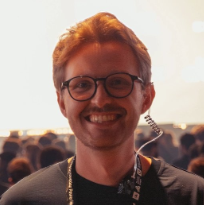 Maarten Beyens, Marketing & Design Lead, SuperNova Festival
Thirty-three folders deep, and still on the wrong day
When Maarten joined SuperNova, event photography lived in dozens of Google Drive folders sorted by day, then spread across events, speakers and stages. Some albums sat on a freelancer's personal Google Photos account instead of SuperNova's own, which meant no central access, no consistent structure and no clear ownership.
Sharing was just as painful. When a partner needed photos of their booth, the team searched manually across folders, created a new Google Drive folder and shared it. Every time. For the first edition, SuperNova tried an external platform that promised to deliver photos to speakers and pitchers automatically. It never worked. The team ended up forwarding hundreds of images by hand, album by album.
Maarten puts the old workflow bluntly: with Google Drive you click through thirty-three folders and still end up on the wrong day.
Tags before the doors open
SuperNova adopted Clipido as a single database for all event photography. Before the festival opened, Maarten set up a tag for every speaker, session and stage. When photos arrived from photographers, they slotted straight into the right context. No renaming, no folder navigation, no risk of filing in the wrong place.
The tag structure replaced the mental map he used to carry in his head. I need a photo, I search for it, and I get it, he says. That simplicity is the whole point.
Visual search added another layer. When the design team needed a shot of the SuperNova bar for a brochure, or the partnerships team wanted to show a sponsor what their booth looked like, Maarten typed a description and had results in seconds. No folder paths to remember.
One tagged photo, every face in the library
Face recognition became the biggest operational shift. Previously, building a photo album for a speaker meant scrolling through hundreds of images to find the right faces. With Clipido, Maarten tagged one photo per speaker. The system found that person across the entire library automatically.
Building and sharing a complete speaker album became a single click. What used to be hours of manual selection turned into a workflow the team could run while the festival was still happening.
Maarten describes Clipido as the power of Google Drive combined with the album distribution of Flickr, with serious AI face recognition behind it.
Real-time on the mainstage
The mainstage is where time pressure is sharpest. Photographers upload throughout each session. Because session tags are already in place, photos can be reviewed and filed the moment they arrive. The goal is simple: get a post live before the speaker leaves the stage.
In ninety-five percent of cases, it works. A photo comes in, lands on the right speaker tag and appears on social media while the audience is still in the room.
For pitch sessions, the same tag-first approach carried over from the previous year, this time inside Clipido instead of manually structured Google Drive folders. Faster, and far less error-prone.
Controlled access when the guest list is different
SuperNova runs more than one type of event. For An Evening with Arnold Schwarzenegger, a separate high-profile show, photo access had to be tightly managed. Every upload went into a review queue. Maarten marked each image as public, private or pending. Behind-the-scenes shots, crew moments and backstage images stayed private. Only a handful were cleared for distribution to attendees.
On the visitor side, SuperNova activated shared galleries with face recognition. More than twelve thousand festival attendees could find photos of themselves without creating an account or contacting the team. The accuracy surprised even Maarten: even images where someone is barely visible still produce a correct match.
After the festival, the same library keeps paying off. Partner photo requests that once meant searching through dozens of folders now take seconds. Brochure design, website updates and press selections all draw from one searchable archive.